Smart-1 Lunar impact Project

Secção Lunar / REA - BRASIL

PORTUGUÊS - - ESPAÑOL

Friday, August 11, 2006

Lunar Impact


Artistic conception of meteor impact. Credit: NASA


7th of November, 2005 - NASA scientists observe an explosion in the Moon with energy of approximately 70kg of TNT, which occurred close to the edge of Mare Imbrium (sea of rains).

Probably, the cause was a 12cm meteorite that slammed on the lunar surface at a speed of about 97.200 km/h. The impact may have opened a small crater of about 3 meters of width and 0,4 meters of depth. It was so small that even the Hubble space telescope could not see it.
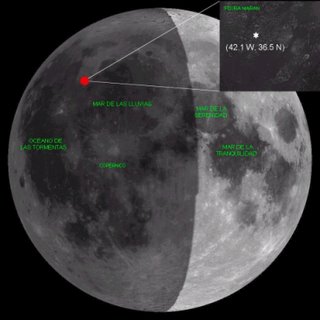


Credits of the image: NASA/MSFC/Bill Cooke


The image of this shock, which reached 7 of visual magnitude, was captured with a video camera connected to a 25cm telescope of opening, by Rob Suggs and his colleague Wes Swift of the Marchall Space Flight Center - MSFC.


Sequence of 6 frames of the video, in false color. Credits of the image: Wes Swift/NASA.

posted by Seção Lunar REA - Brasil at 8:30 PM

Moon SMART-1 Impact Campaign


Artistic representation of SMART- 1 around the Moon. Image: ESA


17th of August, 2006. If we could observe the distant and dark size of the Moon from the Earth, we would watch, in this same day, a similar event to the meteor impact registered by NASA researchers.

In this day, the lunar spaceship SMART-1 (Small Missions for Advanced Research in Technology) of the European Space Agency- ESA, would have its main source of fuel depleted (Xenon – Xe) and would naturally slam against the lunar surface, finishing its successful mission for qualification of its ionic propulsion engine and its observations and studies of the Moon composition, which started with its launching in September, 2003.

We cannot obviously observe the impact in the dark side of the Moon but, we can postpone it and program it for occurring in the visible side, enabling our telescopes for viewing the impact from the Earth, for the necessary analyses.

This is being made. 3rd of September, 2006 is the new established date for the impact. In this day, in the closest side of the Moon, on the dark part near the terminador, the lunar spaceship SMART-1 will slam against the lunar surface.
In order to things work, some technical adjustments have been executed since the 19th of June and must be concluded until the 2th of July. These adjustments will impulse the spacecraft raising its perilune 90 km above its normal orbit.
A further series of minor manoeuvres may be performed on 27 and 28 July, 25 August and on 1 and 2 September 2006 to adjust the SMART-1 trajectory.


Predicted evolution of the perilune ray from the 19th of June until the 3rd of September, 2006. Credit of the illustration: European Space Agency - ESA


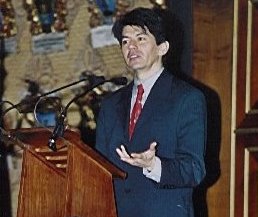
Dr. Bernard H. Foing


At this moment, professional and amateur Astronomers (see list in http://www.cosis.net/members/meetings/team.php?team=2442&PHPSESSID=94efc3bd689a33deb8175f1834c3d154 in the end of this article) of some countries, under the coordination of Dr. Bernard H. Foing (photo above), scientist of the SMART-1 Project, are integrating and planning an international research campaign, from the predictions or simulation of impact effects until the observations that will be carried in land by the global astronomical community.

In the project, as in many other astronomical international campaigns, the effective participation of the amateur astronomers will be extremely necessary.

The observations and/or captured images of the impact made by amateurs and the resultant processes will be requested for studies and documentation and then added to the works which will be developed in the big research centers involved in the study:

Asiago Astrophysical Observatory Italy, Paris Meudon observatory, Observatoire Pic du Midi, Observatoire Haute Provence, To silence High Spain, South African Astronomical Observatory, Tenerife (ESA OGS + 1.m infrared), La Palm Roque of los Muchachos/Galileo telescope, LNA/Brazil Itajubá/Pico of the Days, ESO Paranal VLT, ESO La Silla, Cerro Tololo/Chile, Melbourne/Florida Institute tech, Kitt Peak/Arizona, Mauna Kea CFHT (+ IRTF, UKIRT), Zelentchuk/Crimeia, National Astronomical Observatory of Japan (NAOJ) among others.
- A number of observatories have already confirmed their participation to the observing campaign:

. CEA Cariri - Juazeiro do Norte, Ceará, Brazil
. VLBI Very Long Baseline Interferometry and radio observatories
. South African Large Telescope SALT
. Calar Alto
. ESA OGS Optical Ground Station at Tenerife
. Argentina National Telescope
. Florida Tech Robotic telescopes
. Hawaii NASA IRTF
. Japanese telescope
. ODIN observatory (from space)

posted by Seção Lunar REA - Brasil at 8:20 PM

Members of the International Campaign


Artistic impression of SMART-1. Credits: ESA


· SMART-1 STWT and Spacecraft Operations Team

B.H. Foing, D. Koschny, D. Frew, M. Almeida, M. Sarkarati, J. Volp, G. Racca, O. Camino, J. Schoenmakers, G. Schwehm, J.L. Josset, S. Beauvivre, Z. Sodnik, P. Cerroni, A. Barucci, M. Grande, U. Keller, A. Nathues, K. Muinonen et al.

· SMART-1 Coordinated observations group

P. Ehrenfreund, B. Leibundgut, O. Hainaut, K. Meech, D. Wooden , P.Gondoin, J.L. Ortiz, R. Schultz, C. Erd, L. Gurvits, A. C. Cook, G. Cremonese, C. Barbieri, Mario Di Martino, J. Trigo-Rodriguez, N. Bhandari, T. Chandrasekhar, N. Kawano, K. Matsumoto, V. Reddy, M. Wood, S. Vennes, C. Taylor, A. Hanslmeyer, J. Vaubaillon, M. Khodachenko, H. Rucker, et al.

· SMART-1 impact prediction group

D. Koschny, H. Svedhem, A. Rossi, D. Goldstein, P.H. Schultz, L. Alkalai, B. Banerdt, M. Kato, M. Burchell, V. Mangano, A. Berezhnoy, H. Lammer et al.

· SMART-1 amateur astronomer coordination & outreach

M. Talevi, S. Ansari, C. Lawton, J.P. Lebreton, M. Buoso, S. Williams, A. Cirou, L. David, O. Sanguy, J.D.Burke, P.D. Maley, Valmir Martins de Morais, F. Marchis, Juan Miguel Hodar Muñoz, J.L. Dighaye, F. Graham et al.

posted by Seção Lunar REA - Brasil at 8:19 PM

The Impact


Credit of the illustration: European Space Agency – ESA .
At this point, the spacecraft weighing about 285 kilograms - 200 kg of aluminum in its body of 1m3, 3 kg of N2H4 hydrazine, 0,26 kg of Xenon, epoxi, two solar carbon fiber panels and solar stacks AsGa with 6.5 meters each, will slam against the lunar surface at a speed of 7200km an hour, in a descending oblique angle of only 1 degree in an ascending inclination of 2.5 degrees, originating a lengthened crater (similar in format to the ones of Messier A and B) with a size of between 5 to 10 meters.

The kinetic speed of the SMART-1 spacecraft will be lower than the speed of a 1kg meteorite, which reaches the Moon in natural speed of 144.000 km/h or, even lower than the speed of the most massive lunar modules which slammed during the Apollo missions. Due to this low speed and the obliquity of its orbit, its effects will be even more localized.

The adopted models foresee that the resultant flash of the impact will last for only 20 Milliseconds approximately.

The kinetic energy will be of about 600 MJ, and the depth of penetration might be of about one meter. The thermal magnitude of the flash would reach 7.4 if half of the kinetic energy were converted into heat. Anyway, for the adopted model of a 2km speed prediction, an estimated magnitude around 16 will be more realistic (Koschny and Gruen, Koschny 2006).

A volume of 10 to 80m3 of excavated material is expected to result of this impact – 80% lighter and colder, constituted basically of dust of about 15 microns in size (normalized by area) – will be ejected and will be extended through a 25km square area, which will result in a complete darkening of the reached surface and will result after the first minute in signals of partial darkening.

This material, in its totality, is expected to be observed by the reflection of the Earthshine with a magnitude of around V=17 by square kilometer, therefore, only accessible to big instruments. Smaller telescopes will detect only additional brightness the reached area, which due to its raised albedo, will have an additional magnitude of around 13 to 14.

With the normal component of the speed in the order of 130 m/s, it is expected that a small amount of the ejected material (about 1%) may have a vertical speed higher than 280 m/s, which will be sufficient to reach the solar light and become visible. That corresponds to a 100-degree angle of solar phase with a V=11.5 magnitude or smaller , therefore, more easily detectable by the small telescopes. [To see the item: The Observations.]

The lack of more precise data of the lunar topography (the used topographical information has a grid of only 1 kilometer, captured by the Clementine Spacecraft, of the Science and Technology Operations Centre - STOC) also allows the possibility of occurrence of the impact either in the previous orbit or in the subsequent orbit calculated for the nominal impact.

This happens because the spacecraft might slam against some high lunar mount of unknown altitude, located in the way of the calculated trajectories or will either move between these mounts, slamming in a posterior orbit.

posted by Seção Lunar REA - Brasil at 8:00 PM

Spot for the SMART-1 Impact

The impact of the SMART-1 will possibly occur in the dark part of the first quarter moon, in the visible side of the Moon, next to the terminador, in the south of Mare Humorum, in Lacus Excellentiae, on the 3rd of September, 2006 .
This area is very interesting from the scientific point of view. It is a volcanic plane area surrounded by highlands, but also characterised by ground heterogeneities.


Localization of Lacus Excellentiae. Image captured by the Virtuel Atlases of la Lune by Christian Legrand and Patrick Chevalley


Lacus Excellentiae. Credit of the image: Valmir M. Morais (author)


Lacus Excellentiai. Credit of the image: Photo IV-148-H3 of Digital by the Lunar Orbiter Photographic Atlases of the Moon of the Lunar and Planetary Institute - LPI.


New point of impact designated for the author. This mosaic of images, obtained by the Advanced Moon Imaging Experiment (AMIE) on board ESA's SMART-1 spacecraft, shows the SMART-1 landing site on the Moon. Credits: ESA/Space-X Space Exploration Institute/ Rosely Gregio (Brazil)

posted by Seção Lunar REA - Brasil at 7:55 PM

Data and Visibility of the Moon for Impact 0

Nominal Impact: 3rd of September, 2006, 05:42:20.320 UT


SMART-1's impact is currently expected on 3 September 2006 at 05:42:20.320 UT, in the point located at 46.19496º West longitude and 34.26932º South latitude in Lacus Excellentiae.


Lacus Excellentiae. Time of nominal impact. Image captured by the Virtuel Atlas of la Lune de Christian Legrand and Patrick Chevalley.


New point of impact designated for the author. Image obtained by the spacecraft SMART-1. Credits: ESA/Space-X Space Exploration Institute.


Perilune of the Orbit
These are the last orbit prediction we have for SMART-1.
The reference system is W91 and the topographic data is from the NASA Clementine mission.
The data is from the perilune of the orbit.
Revised impact predictions have been generated based on the SMART-1 orbit determination from 1 September 2006.
The calculations include a scheduled manoeuvre in the night of 1/2 September to raise the perilune by 600 m in order to maximise the chance to impact at the nominal perilune.

Time: 2006/09/03 5:42:52.504 UT
Longitude (W91): 313,73194150408 deg
Latitude (W91) : -36,45157493490 deg
Height: 215.199 meters below topographic surface

Visibility of the Moon

Right Ascension (J2000) = 18h34m19,5s
Declination (J2000) = -28°02'10"
Earth-Moon distance = 375.750 km
Apparent lunar diameter = 31,80'
Phase = 62,1°
Lunation = 10,44 days
Illumination = 73,4


Perilune of the Orbit signed by the autor. Lunar Aeronautical Chart Footprint, Moon General Image Viewer, U.S. Geological Survey - U.S. Department of the Interior.


Perilune of the Orbit signed by the autor. Moon General Image Viewer, Planetary Interactive G.I.S. on the web, U.S. Geological Survey - U.S. Department of the Interior.


Perilune of the Orbit signed by the author. Photo IV-148-H3 of the Digital Lunar Orbiter Photographic Atlas of the Moon - Lunar and Planetary Institute - LPI.


Perilune Nominal Orbit. Image obtained by the spacecraft SMART-1. Credits: ESA/Space-X Space Exploration Institute.


Day/Night on Earth. Image captured by the author with the Earth View Program. Credit: Earth View, Earth and Moon Viewer by John Walker.


The Moon view shows the area of the Earth where the Moon is above the horizon. Credit: Day and Night Across the Earth, U.S. Naval Observatory.


Location............................. Local Time...... Alt. Moon....... Alt. Sun

São Paulo, Brazil................... 02:42 day 03...... +00°49' (w)..... -48°20'
Buenos Aires, Argentina.......... 02:42 day 03...... +14°44' (w)..... -52°14'
Paris, France....................... 06:42 day 03...... -59°29'.......... +04°53'
Cananga, Republic of Congo...... 07:42 day 03...... -54°36'.......... +17°26'
Rome, Italy......................... 06:42 day 03...... -69°05'.......... +11°29'
Madrid, Spain...................... 06:42 day 03...... -58°35'.......... -00°15'
Washington D.C., U.S.A.......... 00:42 day 02...... -04°54' ......... -42°07'
Lisbon, Portugal................... 05:42 day 03...... -54°44'........... -04°38'
Mexico City, Mexico............... 23:42 day 02...... +21°42' (w)......-59°26'
Sydney, Australia.................. 15:42 day 03...... +37°51'...........+21°58'
Santiago, Chile..................... 01:42 day 03...... +23°46' (w)..... -59°48'
Tucson, Arizona (USA)............. 22:42 day 03...... +26°46' (w)..... -43°23'
Havaii, USA......................... 19:42 day 03...... +39°52' (w)..... -16°59'

posted by Seção Lunar REA - Brasil at 7:50 PM

Data and Visibility of the Moon for Impact Orbit -1

Nominal Impact Orbit -1 (00:37:54.709 UT)

These are the last orbit prediction we have for SMART-1.The reference system is W91 and the topographic data is from the NASA Clementine mission.
The data is from the perilune of the orbit.

Revised impact predictions have been generated based on the SMART-1 orbit determination from 1 September 2006.
The calculations include a scheduled manoeuvre in the night of 1/2 September to raise the perilune by 600 m in order to maximise the chance to impact at the nominal perilune.


Lacus Excellentiae. Time of Impact orbit -1Image captured by the Virtuel Atlas of la Lune by Christian Legrand and Patrick Chevalley


Visibility of the Moon

Right Ascension(J2000) = 18h22m44,3s
Declination (J2000) = -28º46'32"
Earth-Moon distance = 377.867 km
Apparent lunar diameter = 31,62'
Phase = 64,8°
Lunation = 10,23 days
Illumination = 71,3%

1 Orbit Before Impact

Time: 2006/09/03 00:37:54.709 UT
Longitude (W91): 316,50051484751 deg
Latitude (W91) : -36,46925842646 deg
Height: 2056.054 meters over topographic surface.


Impact signed by the autor. Lunar Aeronautical Chart Footprint, Moon General Image Viewer, U.S. Geological Survey - U.S. Department of the Interior.


Impact signed by the autor. Moon General Image Viewer, Planetary Interactive G.I.S. on the web, U.S. Geological Survey - U.S. Department of the Interior.


Impact signed by the author. Photo IV-148-H3 of the Digital Lunar Orbiter Photographic Atlas of the Moon - Lunar and Planetary Institute - LPI.


Impact signed by the author. Images obtained by the spacecraft Clementine. Credit: NASA.


Day/Night on Earth. Image captured by the author with the Earth View Program. Credit: Earth View, Earth and Moon Viewer by John Walker.


The Moon view shows the area of the Earth where the Moon is above the horizon. Credit: Day and Night Across the Earth, U.S. Naval Observatory.


Location........................Local Time.....Alt. Moon.........Alt. Sun

São Paulo, Brazil............. 21:37 day 02.... +63°26' (w)....... -50°40'
Buenos Aires, Argentina.... 21:37 day 02.... +74° 08'(w)....... -37°19'
Paris, France................. 01:37 day 03.... -13° 58'........... -31°47'
Cananga, Rep. of Congo.... 02:37 day 03.... -04° 13'........... -57°19'
Rome, Italy................... 01:37 day 03.... -17° 19'........... -35°45'
Madrid, Spain................ 01:37 day 03.... -05° 57'........... -40°55'
Washington D.C., U.S.A.... 19:37 day 02.... +21°44' (w)........ -11°50'
Lisbon, Portugal............. 00:37 day 03.... -01° 34'........... -42°56'
Mexico City, Mexico......... 18:37 day 02.... +36°03'............ +02°10'
Sydney, Australia............ 10:37 day 03.... -14°03'............. +44°40'
Santiago, Chile.............. 20:37 day 02.... +83°32' (w)........ -27°49'
Tucson, Arizona (USA)...... 17:37 day 02.... +19°37' (w)........ +13°31'
Havaii, USA.................. 14:37 day 02.... -00°25'............. +54°05'

posted by Seção Lunar REA - Brasil at 7:40 PM

Data and Visibility of the Moon for Impact Orbit +1

Nominal impact Orbit +1 (10:47:49.998 UT)

These are the last orbit prediction we have for SMART-1. The reference system is W91 and the topographic data is from the NASA Clementine mission.
The data is from the perilune of the orbit, the impact will happen minutes before.

Revised impact predictions have been generated based on the SMART-1 orbit determination from 1 September 2006.
The calculations include a scheduled manoeuvre in the night of 1/2 September to raise the perilune by 600 m in order to maximise the chance to impact at the nominal perilune.


Lacus Excellentiae. Time of Impact orbit +1. Image captured by the Virtuel Atlas of la Lune by Christian Legrand and Patrick Chevalley

Visibility of the Moon

Right Ascension (J2000) = 18h51m43,7 s
Declination (J2000)= -27º26'57"
Earth-Moon distance = 373.963 km
Apparent lunar diameter = 31,95'
Phase = 59,4°
Lunation = 10,65 days
Illumination = 75,5%

1 Orbit after Impact

Time: 2006/09/03 10:47:49.998 UT
Longitude (W91): 310,96356203210 deg
Latitude (W91) : -36,42740130684 deg
Height: 2149.739 meters below topographic surface


Impact signed by the autor. Lunar Aeronautical Chart Footprint, Moon General Image Viewer, U.S. Geological Survey - U.S. Department of the Interior.


Impact signed by the autor. Moon General Image Viewer, Planetary Interactive G.I.S. on the web, U.S. Geological Survey - U.S. Department of the Interior.


Impact +1 orbit signed by the author. Photo IV-148-H3 of the Digital Lunar Orbiter Photographic Atlas of the Moon - Lunar and Planetary Institute - LPI.


Image obtained by the spacecraft SMART-1. Credits: ESA/Space-X Space Exploration Institute.


Day/Night on Earth. Image captured by the author with the Earth View Program. Credit: Earth View, Earth and Moon Viewer by John Walker.


The Moon view shows the area of the Earth where the Moon is above the horizon. Credit: Day and Night Across the Earth, U.S. Naval Observatory.


Location........................Local Time.....Alt. Moon.........Alt. Sun

São Paulo, Brazil............. 07:47 day 03.... -38°18' .......... -20°01'
Buenos Aires, Argentina.... 07:47 day 03.... -25° 35'.......... +07°06'
Paris, France................. 11:47 day 03.... -50° 25'........... +46°41'
Cananga, Rep. of Congo.... 12:47 day 03.... -19° 57'........... +75°48'
Rome, Italy................... 11:47 day 03.... -44° 23'........... +55°19'
Madrid, Spain................ 11:47 day 03.... -56° 28'........... +51°57'
Washington D.C., U.S.A.... 05:47 day 03.... -58°45' ........... +01°27'
Lisbon, Portugal............. 10:47 day 03.... -60° 50'........... +50°32'
Mexico City, Mexico......... 04:47 day 03.... -37°14'............ -21°35'
Sydney, Australia............ 20:47 day 03.... +77°28'(w)........ -38°59'
Santiago, Chile.............. 06:47 day 02.... -22°53' ........... -02°07'
Tucson, Arizona (USA)...... 03:47 day 02.... -31°07' ........... -26°20'
Havaii, USA.................. 00:47 day 02.... +09°13' (w)....... -61°52'

posted by Seção Lunar REA - Brasil at 7:30 PM

The observations


Jean Nicolini Municipal Observatory, in Campinas, Brazil. Partner of the Project.


Beyond being able to help simulating and understanding the processes that occur in temporary natural impacts, the observation of a collision in dry soil conditions can be used as experience for controlling to a future impact aiming the diagnosis of the polar ice of the Moon.

The interest for the contribution of large telescopes from the Earth in this project lies in its easiness for collecting a great number of photons in angular resolutions lower than 0,4 second of arch or still in the use of its adaptive optic system for the detection of the flash of the impact, making possible the observation of the structure of the ejected materials and its dynamics, or yet some traces and dynamics of gas clouds of the hydrazine with a resolution lower than 100 meters.

The works in land aim the capturing of infrared images of the evolution of the thermal flash and the observation under Earthshine and under solar light - either at visible conditions or at infrared - of the speed and the dynamics of unfastened clouds of dust, as well as the spectroscopic features of this material, which may generate improvements in the understanding of other processes, such as the degree of hollowing and the effects related to the gravitational force.

The spectral distribution of the energy and the comparative observations of the reflectance of the dust can supply quantitative features such as the mineral composition, the porosity, cristallinity and the distribution and analysis of the thin layers (until a meter of depth) of the lunar surface. These upper layers, exposed to cosmic rays and to solar particles, are modified in such a way that they weaken their mineral signature when spectroscopic analyses are carried out.

The observations in infrared, in particular the infrared range from 2-20 microns, would allow a constraint on the present lunar minerals (pyroxene, olivine) on the main aims, which would complement the SMART-1 diagnostics - high resolution multicolor camera (lower than 40 m/píxel) AMIE used in the band of 0.95 micron of the pyroxene and spectrometry infrared – SIR, on 0.9-2.5 microns band. A special care is needed for limiting and correcting the light that comes from the illuminated part of the half moon, beyond the 60 seconds of arc in the east of the terminator.

After a short lasting thermal flash, there might be a remaining increase of the temperature of the lunar soil, which reaches about -173°C (100ºK) at night. The cooling can be monitored by some hours through the thermal images in infrared.

The impact will not be visible at naked eye.It is expected that the dust cloud generated by the impact might be visible (with telescopes) during some minutes.

It is difficult to estimate precisely the reflexibility, the size of particles (therefore normalized by area) and the amount of the ejected material. It is probable, however, that this cloud may have a lower visual magnitude or yet higher than the one initially calculated. Because of this, we insist that the amateur astronomers join and carry out observations of the event.

The dry air during the time and in the observation spot, of course, will collaborate to the recording of the occurrences after the impact. The humid air which disperses the brightness of the Moon (moonlight), which increases extremely the brightness of the sky, will make it difficult to see the dust cloud raised during the event.

The use of webcams will be extremely useful.By allowing the recording of hundreds of images in a short space of time, frame-by-frame occurrences can be detected, and the weak details can be enhanced to improve its visualization.

The observers who will pursue the ejected material in the Earthshine or under solar light through the images in high resolution at visible light or with the use of filters, through CCD or video, should not forget that, due to the brevity of the event, that the images must have accurate the time and place of the event inserted on the frames in order for having any scientific value.

It is also requested that from now on, in order to be used later as evidence – after the impact and after the falling of the ejected materials, possible changes of colors, topography or other new characteristics - high resolution images of the points of impact in different lunar phases (angles of observation and illumination) are captured with or without the use of filters.

In Brazil, the Lunar Section of Astronomia Observacional's Net-REA http://www.reabrasil.org/lunar/, is developing and coordinating a nationwide observation project named SL/REA SMART-1 Lunar Impact Project http://www.reabrasil.org/lunar/smart1impact.htm which is coordinated by Ms. Rosely Gregio - rgregio@uol.com.br Chief Coordinator of the Lunar Section, Mr. José Serrano Agustoni - agustoni@yahoo.com Manager of Lunar Impact Projects and Mr. Valmir Martins de Morais - valmirmmorais@yahoo.com.br Member of the Team of Observers of the SL/REABr (Lunar Section - REA-BRASIL) and of the international campaign Moon SMART Impact: Predictions and Observation Campaign that Juan also counts in its rows with the observing Brazilian Miguel Hodar Muñoz - Manager for the Project Lunar Topography of the SL/REABr.

Campaign SL/Lunar REA SMART-1 Impact Project will coordinate and collect all the data, comments and images preliminary and gotten of the event for the observers in the country and will directly send they for study and analysis to the general coordination of Moon SMART Impact: Predictions and Observation Campaing - ESA Scientific - SMART-1 under the responsibility of the Dr. Bernard H. Foing, e, from it, for several other interested scientific institutions.

These data will have to also be inserted in the site of the national project and will be the disposal of the researchers and centers of research.

The Association of Lunar & Planetary Observers- ALPO is, at the moment, developing a program called ALPO Smart Impact Project - http://www.zone-vx.com/alpo-smartimpact.html .
Its coordinator, Mr. Brian Cudnik - cudnik@sbcglobal.net , will compile and submit to the ESA, the preliminary and the captured observations of the event for the lunar observers of this project. The Website maintenance: William M. Demboswki, FRAS - mailto:mdembowski@zone-vx.com
Let’s remember that: " Astronomy is contribution ". Words of Júlio Lobo

posted by Seção Lunar REA - Brasil at 7:25 PM

Calibration of the observations


Eartshine in 11-03-2005. credit: NASA


Earthshine. Credit of the illustration: Robert Knop


In order to get familiarized with the impact area, with the calibration and reduction of the aspects of stray light , the observations and the acquisition of images at visible light and with filters in this region will be held within months before the event is carried.

Perform some images of the impact site (which is in the dark...) to check the straylight level. For PR purposes, do some tests with the illuminated part in the field of view (if your field of view is large enough) and do some tests with the illuminated part in the field of view (if your field of view is large enough).

Perform some image the complete Moon at the same phase as during the impact.

Perform some long-exposure images to see the unilluminated side of the Moon in earthshine - this we would use during the actual impact to search for ejecta clouds at visible light and with filters.

The conditions – including technical - must be similar to the ones which will be carried in September - same instruments, closes, filters, same lunar phase (interval of 29.53 days), darkness and distance from the terminator.

Obeying to these criteria, the observations must be held during the following days:
5th to 6th of July and 3rd to 4th of August.

It is strongly encouraged that the observer use this time (or the days preceding or following if the day of choice is clouded out) to practice with their setup, assess stray light problems and take steps to minimize this.

posted by Seção Lunar REA - Brasil at 7:15 PM

Calibration of the observations - Images

Some of the images of calibration, by date, sent by members of the Campaign SL/REA Brazil SMART-1 Lunar Impact Project:


Image obtained by Rosely Gregio - Mococa, São Paulo, Brazil. Day 06/Julho/2006 at 21:40 GMT. MCT telescope 90 mm, F/13.8. Eyepiece 26 mm + Sony DSC-W5, 5.1 MP, ISO 100. Time Exp 125 sec. B & W. Fine. Afocal. Image without treatment.


Image obtained by Eduardo Alejandro Pulver - Rosario, Prov. de Santa Fe, Argentina.


Image obtained by Eduardo Alejandro Pulver - Rosario, Prov. de Santa Fe, Argentina.


Image obtained by Gerardo Addiego - Montevideo, Uruguay. 03/Agosto/2008 day. Vesta Pro Webcam, Telescope Newtonian 114 mm, F/8 + Barlow x2. Processed with Registax3.


Image obtained by Rosely Gregio - Mococa, São Paulo, Brazil. Day 03/Agosto/2006 at 21:20:23 GMT. MCT 90 mm telescope, F/13.8. Eyepiece 26 mm + Sony DSC-W5, 5.1 MP, ISO 200. Exp. Time 125 sec. Bad Seeing and Cirrus.


Image obtained by Rosely Gregio - Mococa, São Paulo, Brazil. Day 03/Agosto/2006 at 21:31:03 GMT. MCT 90 mm telescope, F/1200 mm. Eyepiece 26 mm + Sony DSC-W5, 5.1 MP, ISO 200. Exp. Time 140 sec. Zoom 3X.Bad Seeing and Cirrus.


Image obtained by Guilherme Grassmann - Americana, São Paulo, Brazil. Day 04/agosto/2008 at 21:51:58 GMT. Seeing: 6/10. Transp.:7/10. SCT 10" telescope, FD/10 + Focal redutor 0.63. No filter.Toucam Pro. Shutter speed 1/50.


Image obtained by Guilherme Grassmann - Americana, São Paulo, Brazil. Day 04/agosto/2008 at 22:21:28 GMT. Seeing: 7/10. Transp.:8/10. SCT 10" Telescope, FD/10 + Focal Redutor 0.63. Filter: UV/IR Cutter .Toucam Pro. Shutter speed 1/50.


Image obtained by Juan M.Hodar Muñoz and Felipe Hodar Luengo - Campinas, São Paulo, Brazil. Day 04/Agosto/2008 at 23:09:39,690 GMT. Telescope with 200 mm of opening, F/8.


Image obtained by Juan M.Hodar Muñoz and Felipe Hodar Luengo- Campinas, São Paulo, Brazil. Day 04/Agosto/2008 at 23:09:41,510 GMT. Telescope with 200 mm of opening, F/8.


Image obtained by Fabio H. Carvalho - São Carlos, Brazil. Day 04/agosto/2006 at 23:58 GMT. Phillips Toucam Pro II. Telescope with 254 mm of opening, F/6.


Image obtained by Fabio H. Carvalho - São Carlos, Brazil. Day 04/agosto/2006 at 23:16:22 GMT. Kodak DX7630 Digital Camera. ISO 200. Zoom 3X. Telescope with 254 mm of opening, F/6.


Image obtained by Juan M.Hodar Muñoz and Felipe Hodar Luengo- Campinas, São Paulo, Brazil. Day 05/Agosto/2008 at 21:08:57.880 GMT. Telescope with 200 mm of opening, F/8.


Image obtained by Weber de Brito Barbosa - São Paulo, Brazil. Region lacus Excelentiae . Day 05/agosto/2006 at 01:08:39.236 GMT. Toucam pro II Camera, 640x480 pixels, coupled with a primary focus of Newtonian 250mm. f/5, 1/500 shutter speed, no filter, no processing, terminator on the right, south up.


Image obtained by Miguel Arizu, Gerardo Dalla Torre, Martín Olivera and Raul Cañete -Mendoza, Argentina. Day 06/agosto/2008 at 03:27 GMT. DSC-W5 Digital Camera. 150 mm Hokken telescope F. 1000 mm. Meade Eyepiece SP 20 mm. Exposition: 1/25 f:8. ISO 100. Image without processing.
Image obtained by Juan M.Hodar Muñoz e Felipe Hodar Luengo- Campinas, São Paulo, Brazil. Day 06/Agosto/2008 at 19:02:57.305 GMT. Telescope 200 mm of opening F/8.


Image obtained by Weber de Brito Barbosa - São Paulo, Brazil. Day 06/agosto/2006 at 23:10:44.554 GMT.Toucam pro II in primary focus of Newtonian 250mm, f/5. 640x480 pixels. 1/25 shutter speed, no filtros, no processing, terminator on the right, north up.


Image obtained by Miguel Arizu, Gerardo Dalla Torre, Martín Olivera and Raul Cañete - Mendoza, Argentina. Day 07/agosto/2008 at 03:20 GMT. DSC-W5 Digital Camera. Exp. 1/13 sec., ISO 100.150 mm Hokenn telescope, F/ 1000 mm. Meade Eyepiece SP 10 mm. Imagem without processing.

posted by Seção Lunar REA - Brasil at 7:13 PM

Members of the Campaign SL/REA SMART-1 Lunar Impact Project


Countries Represented in the Campaign SL/REA SMART-1 Lunar Impact Project


  • Argentina


  • Bolívia


  • Brasil


  • Colombia


  • México


  • Paraguay


  • Peru


  • Uruguay


  • Venezuela


Institutions:


Logos of Institutions represented in the Campaign SL/REA SMART-1 Lunar Impact Project


  • Asociacion de Clubes de Astronomia del Atlântico - Colombia


  • Astrotecno - Grupo de Observadores Aficionados - México


  • Centro de Estudos Astronômicos de Alagoas (CEAAL)- Brasil


  • Clube de Astronomia de Niterói "Mário Schenberg" - Brasil


  • Clube de Astronomia de São Paulo (CASP) - Brasil


  • Club Sur Astronómico - Argentina


  • Grupo 47 del Tucán / Red de Observadores del Uruguay - Uruguay


  • Grupo Áster - Brasil


  • L.I.A.D.A - Argentina


  • LaborAstro Laboratório de Astronomia/Fac. de Física /PUCRS - Brasil


  • Observatorio Astronomico Albert Einstein - Brasil


  • Observatório Astronômico Liais - Brasil


  • Observatotio Astronómico Nacional de Tarija - Bolívia


  • Observatorio Astronomico Universidad Serio Arboleda -Colômbia


  • Observatório CEA-Cariri / Estação Astronômica PieGise - Brasil


  • Observatorio Kepler - Venezuela


  • Observatório Municipal de Campinas Jean Nicolini - Brasil


  • Observatório Sagitário - Brasil


  • Planetarium Maria Reiche - Peru


  • Rede de Astronomia Observacional/REA - Brasil


  • Rede Marcgrave de Astronomia - Brasil


  • Secção Lunar /Rede de Astronomia Observacional - Brasil


  • Sociedad Astonomica del Planetario Alfa - México


  • Sociedad Astronomica Queretana A.C.- México


  • Sociedad de Estudios Astronómicos (SEA) - Paraguay


Members of the Campaign:


Credit of the original illustration: ESA Science


  • Alan Franco Rosa - São Gonçalo, Brasil


  • Alberto Leon Cadena - Toluca, Mexico


  • Alexandre Rodrigues- São Paulo, Brasil


  • Belen Del Puerto - Asunción, Paraguay


  • Barthelemy d´Ans - Yanahuara, Peru


  • Carlos Alberto Krawczenko - Buenos Aires, Argentina


  • Carlos Rossatti - Montevideo, Uruguay


  • Ciro Acosta - Asunción, Paraguay


  • Enrique Torres - Barquisimeto, Venezuela


  • Erquinio Alberto Taborda Martinez - Barranquilla, Colômbia


  • Fabio H. Carvalho - São Carlos, Brasil


  • Felipe Hodar Luengo - Campinas, Brasil


  • Flavio Pereira - São Paulo, Brasil


  • Gerardo Addiego - Montevideo, Uruguay


  • Gerardo Dalla Torre - Mendoza, Argentina


  • Guilherme Grassmann - Americana, Brasil


  • Itamar Batista Ramos - Belo Horizonte, Brasil


  • Ivandel Xavier Lourenço - Porto Alegre, Brasil


  • Jairo Andres Chavez - Popayán, Colombia


  • Januario Silvino Pereira Neto - Juazeiro do Norte, Brasil


  • Joaquim Carlos Freire da Silva - Manaus, Brasil


  • Jose de Jesus Muñoz Gonzalez - Queretaro, México


  • Jorge Gomes da Silva - São Paulo, Brasil


  • Juan M.Hodar Muñoz - Campinas, Brasil


  • Julio César F. Lobo - Campinas, Brasil


  • Lucas Benevides Viana de Amorim - Maceió, Brasil


  • Manuel Gabriel Cabrera López - Monterrey, México


  • Manuel Vallejo Robledo - México D.F., México


  • Martín Olivera - Mendoza, Argentina


  • Miguel Arizu - Mendoza, Argentina


  • Néstor Fabián Villalba Capdevila - Asunción, Paraguay


  • Pável Balderas Espinoza - Tarija, Bolívia


  • Paul Núñez - Bogotá, Colombia


  • Pierson Barreto - Recife, Brasil


  • Raul Cañete - Mendoza, Argentina


  • Raul Joya - Bogotá, Colombia


  • Ricardo Fabiano Rocha - Indaiatuba, Brasil


  • Ronaldo Rogério Pedrão - Sumaré, Brasil


  • Rosely Gregio - Mococa, Brasil


  • Valmir Martins de Morais - Juazeiro do Norte, Brasil


  • Vincent Figueres - Asunción, Paraguay


  • Viviana Benítez González - Asunción, Paraguay


  • Weber de Brito Barbosa - São Paulo, Brasil

posted by Seção Lunar REA - Brasil at 7:11 PM

SMART-1: Crash into the moon

The SMART-1 impact took place on 3 sept on lunar orbit 2890 at spacecrafttime 05:42:21.759 (time of generation of last received packet). The JIVE radio telescope from Hobart Tasmania measured a loss of signal at 05H42:22.394 UTC.

Beware that the time specified below, 05:42:21.759, according to the Mission Control people, is the Spacecraft Event Time. It does not necessarily coincide with the Universal Time used for events detected by ground-based telescopes. The difference between the two scales must be checked with the Mission Control Team. It can be non-negligible (e.g. 1.25 s of light propagation Moon-Earth).


Credits: JIVE (NL), ATNF (Australia), Univ. of Tasmania (Australia), TIGO (DE/Chile).


The Point of the Chash


Coordinates longitude 46.20 West, latitude 34.4 South. .


Depicts: SMART-1 Impact Site. Copyright: CFHT. An image from the CFHT showing the projected impact site for SMART-1 24 hours before impact. The image was acquired with the 3.6 m telescope using an H2 filter with a central wavelength of 2122nm and a bandwidth of 32nm.


Credits: Christian Veillet. Canadá-France-Havaí Telescope-CFHT.


Credits: Christian Veillet. Canadá-France-Havaí Telescope-CFHT.


Credits: Christian Veillet. Canadá-France-Havaí Telescope-CFHT.


This mosaic of images, obtained by the Advanced Moon Imaging Experiment (AMIE) on board ESA's SMART-1 spacecraft, shows the SMART-1 landing site on the Moon. Credits: ESA/Space-X Space Exploration Institute and Rosely Gregio (Brazil)..


Impact point signed by the author. Photo IV-148-H3 of the Digital Lunar Orbiter Photographic Atlas of the Moon - Lunar and Planetary Institute - LPI.


Image obtained by the spacecraft Clementine/NASA. Moon General Image Viewer, Planetary Interactive G.I.S. on the web, U.S. Geological Survey - U.S. Department of the Interior.

posted by Seção Lunar REA - Brasil at 7:10 PM

SMART-1: Crash into the Moon Part 2


SMART-1 impact flash seen by CFHT telescope


Credit line : Canada-France-Hawaii Telescope- CFHT, 2006.


Above an animation showing a sequence of 20 images covering the impact which is seen only on one image.

This impressive sequence of SMART-1 impact images was captured by the 3.6-meter optical/infrared Canada-France-Hawaii Telescope (CFHT), Hawaii, 3 September 2006.

The CFHT observed the projected impact area between 07:00 - 08:44 CEST (05:00 06:44 UT). The impact flash lasted only about 1 millisecond. It may have been caused by the thermal emission from the impact itself or by the release of spacecraft volatiles, such as the small amount of hydrazine fuel remaining on board.


Credit line: Canada-France-Hawaii Telescope- CFHT, 2006.


The observations were made with the WIRCam wide-field infrared, 10s exposure time - H2 narrow-band filter at 2122 nanometers with a 32 nanometers bandwidth. Image size: 2' x 2' (or ~200km x 200km).


Contour Plot of Impact Flash

Credit line: Canada-France-Hawaii Telescope- CFHT, 2006.


This contour map of the flash, so bright that it is saturated, shows that the North (top) and South (bottom) of the flash are not identical.

There is a clear elongation on the South side in the direction of the motion.

The elongations at 45 degrees are due to the diffraction pattern from the secondary mirror supports (the spider). The units on the axes of the graph are WIRCam pixels: 0.3" or ~0.5km.


Impact Dust Cloud


Analysis of images obtained at the Canada-France-Hawaii Telescope - CFHT (3.6 meters) by Christian Veillet have revealed a plume of debris thrown up when SMART-1 impacted the lunar surface.
The observation were made with the WIRCam wide-field infrared camera with 10s exposure time througha an H2 narrow-band filter at 2122 nanometers with a 32 nanometers bandwidth.
Each image is approximately 2'x 2', equating to 200 km x 200 km.Below an animation showing the scene of the impact from the exposure just before the impact to ~130s later (~10 images). In order to look at the dust generated by the impact, the scene from before the impact has been substracted from all the images.
Each image is a snapshot over 10s, with a gap of around 5s between exposure.The expansion of the dust cloud is clearly seen... No processing to enhance the signal and minimize the background noise has been made on these images.


Credits : Canada-France-Hawaii Telescope - CFHT / 2006.


Another animation where the dust cloud is seen...


Credits : Canada-France-Hawaii Telescope - CFHT / 2006.


Below, a mosaic of 15 exposures starting with the one at the time of the flash.


Credits: Canada-France-Hawaii Telescope - CFHT / 2006.


Direction of the cloud of dust. Credits: Christian Veillet. Canadá-France-Hawai Telescope-CFHT.


Flash Captured by Amateur Astronomer


The flash below was captured by amateur astronomer Peter Lipscomb in Saint Fe, New Mexico (USA).


Credits: Peter Lipscomb, Saint Fe, New Mexico (USA)


In the images, the terminator is to the right of the field of view. There is some gradiant shown in the frame which appears to darken the more one looks to the left. Lunar North is down.

Complete Animation in: http://cosmonut.org/Smart-1.gif

Peter used a Meade LX-90 Schmidt-Cassegrain and Philips ToUcam webcam for the capture.It was fitted with a 1.25" Schuler Luminance filter on it at the time of capture.As captured, the file shows a native resolution of 320 X 240 pixels with a 0:01:05 duration at 5 frames per second and 12 bit video sample size.

Camera settings were at a pretty high gain and saturation since.Creation time is shown as 09/03/06 at 05:40:51 UT.The times are not accurat.

Peter made one update on time synchronization after your captures and noted an adjustment of close to a minute.

posted by Seção Lunar REA - Brasil at 7:09 PM

Reports of Observations of the Campaign SL/REA SMART-1 Lunar Impact Project


Alguns dos instrumentos utilizados para a observação do impacto.

Observador: Dennis Weaver de Medeiros Lima
Local: Fortaleza / Ceará – Brasil
Reporte: Negativo
Comentários: Aqui em Fortaleza a primeira órbita estimada em 00:38 UT o céu permaneceu encoberto.Não obtive nenhuma imagem da Lua. A segunda órbita as 05:42 UT a Lua já se encontrava abaixo do nosso horizonte. Agora é procurar o ponto de impacto,se for possível observa-lo.

Observador: Fabio H. Carvalho
Local: São Carlos / São Paulo - /Brasil
Reporte: Negativo
Comentários: Aqui em São Carlos (SP) a Lua já brilha forte, porém, ela estará tão próxima da linha do horizonte no horário previsto que eu já deixo aqui o meu reporte negativo, infelizmente.

Observador: Gerardo Addiego
Local: Montevideo – Uruguay
Reporte: Negativo
Comentários: Desde Montevideo resultó imposible observar nada. Un denso manto de nubes y vientos de 50-80 km/ hr impidieron registrar nada. Lamentablemente un persistente manto de nubes impidió absolutamente ver algo en la Luna. Fue frustrante. Espero que otros colegas hayan corrido con mejor suerte.

Observador: Marcelo Domingues
Local: Brasília / DF – Goiás – Brasil
Reporte: Negativo
Comentários: Em Brasília céu nublado na hora prevista para o impacto.

Observador: Weber de Brito Barbosa
Local: São Paulo, Brasil
Reporte: Negativo
Comentários: Em São José dos Campos, também, céu completamente nublado.

Observador: Jose de Jesus Muñoz Gonzalez
Local: Queretaro, México
Reporte: Negativo
Comentários: Lo siento, aunque estuvo despejado y montamos varios telescopios, uno de ellos con videocámara, no vimos que sucediera algun flash en la Luna.

Observadores: Juan M. Hodar Muñoz e Felipe H. Luengo
Local: Campinas / São Paulo – Brasil
Reporte: Negativo
Comentários: Infelizmente não deu desta vez. Nossos reconhecimentos a Rosely e ao grande Valmir, que fez um trabalho de grande profundidade, que garante que em qualquer outra campanha como esta teremos resultados memoráveis.

Observador: Julio Lobo
Local: Observatório Municipal de Campinas Jean Nicolini – Campinas / São Paulo – Brasil
Reporte: Negativo
Comentários: Estamos Indo para o Observatório, eu, Adilson e Guilherme. Vamos usar todo nosso poder de fogo para registrar o evento. Infelizmente não temos internet no Observatório. O tempo por aqui não anda muito bom..mas... Fazer Astronomia é Perseverar. Se conseguirmos algo te aviso.

Observador: Alexandre Rodrigues
Local: São Paulo, Brasil
Reporte: Negativo
Comentários: Lamentavelmente não tive céu para poder documentar .
Estiveram presentes, com a intenção de colaborar no projeto, os astronomos amadores: Gilmar e Anderson Militão.
Comentários referentes ao quadrante onde se encontrava a Lua:
02/setembro/2006
22:30 - névoa forte, alto cumulos e alto stratos
23:30 - pequenas janelas e precipitação
24:00 - névoa fraca alto cumulus alto estratos
03/setembro/2006
00:30 - pequenas janelas, alto cumulus alto estratos
01:00 - pequenas janelas - alto cumulus alto estratos
02:00 - alto cumulus alto estratos
Céu coberto por nuvens altas,precipitação, névoa, pequenas janelas : observação totalmente prejudicada..


Observador: Manuel Vallejo Robledo
Local: México D.F., México
Reporte: Negativo
Comentários: Desgraciadamente en México las nubes no dejaron observar el evento, por lo que espero que en alguna otra parte del mundo haya sido posible verlo y sobre todo el que las personas que lo pudieron observar y tomaron fotos o video, nos las puedan corpartir.

Observador: Guilherme Venere
Local: Campinas /São Paulo - Brasil
Reporte: Negativo
Comentários: O tempo aqui acabou de abrir, mas de acordo com o Starry Night, a lua estará quase no horizonte no momento previsto do impacto, e não será visível do ponto onde estou. Na verdade, ela já esta se escondendo atrás das arvores, portanto infelizmente não tenho como fazer imagens. Reporte negativo aqui de Campinas/SP. Boa sorte para o pessoal que ainda esta na expectativa.

Observador: Rosely Gregio
Local: Mococa / SP – Brasil
Reporte: Negativo
Comentários: Data: 02 e 03 de setembro de 2005. No início das observações o céu estava totalmente nublado. O brilho da Lua não conseguia furar o bloqueio das nuvens. Posteriormente, surgiram alguns buracos por onde se podia entrever a Lua, mas ainda ligeiramente encoberta por névoa. Infelizmente, aos poucos o céu foi ficando ainda mais ruim e a Lua já a muito baixa altitude (além da obstrução de construções) impediram que o evento fosse monitorado. A tentativa de observação foi encerrada a 05:25 UT quando a Lua já estava oculta por construções e por um espesso manto de nuvens. Não foi utilizado um instrumento de maior diâmetro (NEWTONIAN 250mm devido a forte turbulência e altitude do evento)
Imagem: Foram feitas tentativas de fotografar a Lua, mas como as condições atmosféricas com nuvens espessas, turbulência e seeing estavam muito ruins. Conseguimos 3 imagens menos ruins (só para constar).

Observador: Guilherme Grassmann
Local: Americana / São Paulo – Brasil
Reporte: Negativo
Comentários: Olá amigos, por aqui a Lua ficou encoberta durante a orbita 1 e o segundo evento das 5:42 UT a Lua estava a somente a 1° de altitude o que impossibilitou qualquer tentativa de registro. Pelo menos temos o registro do pessoal do CFHT do Havai , por sinal belo registro. Com esta informação será possível determinar com precisão o local exato da queda e assim poderemos tentar examinar a região para ver se algo ficou registrado na superficie Lunar.

Observador: Cristóvão Jacques
Local: Belo Horizonte / Minas Gerais – Brasil
Reporte: Negativo
Comentários: Aqui em BH, céu totalmente nublado.

Observador: Alberto León
Local: Estación Arboleda – astrotecno-Toluca, México -
Reporte:
Comentários:
Altocúmulos desde el Sur hasta el Oeste en un manto que cubrió el hemisferio Sur y que no dejo ver siquiera la Luna, sucedió desde las 00:15 hasta las 00:50 ( T.L. 90°W).
Algunas fotos casuales desde las 20:00 a las 00:05 que les daré a conocer más tarde...
Buena noche: Tamb. 10° , sin viento ni lluvia. Sólo una gran nube en el momento más inoportuno... después una Luna esplendorosa....
Mandaré reporte detallado más tarde.

Observadores: Valmir Martins de Morais e Januario Silvino Pereira Neto
Local: Juazeiro do Norte, Ceará, Brasil
Reporte: Negativo
Comentários: As observações foram iniciadas as 20:50 TU com um céu parcialmente nublado. Embora estivéssemos ciente da programação do impacto para o horário 05:42 UT (horário nominal do impacto 0), devido a margem de erro/ precisão dos mapas topograficos utilizados nas projeções, nos preparamos para um eventual impacto na órbita -1, calculada para as 00:37 TU. No horário, embora com o céu quase totalmente coberto por nuvens espessas, a Lua estava replandescente. Imagens foram obtidas, mas nada foi registrado. A sonda seguiu seu rumo em direção ao ponto de impacto nominal, com a Lua já abaixo do nosso horizonte de observação.

Observador: Sergio Ap. Caixeta
Local: São Carlos / São Paulo – Brasil
Reporte: Negativo
Comentários: Calculei mal e a minha linha de visada tem uma casa na frente.
Infelizmente, estou fora, pois não tenho como me movimentar para outro site.
Aguardo as fotos dos colegas!

Observador: Juan Antonio Páez
Local: Sevilla, Espanha
Reporte: Negativo
Comentários: Desde el principio de la misión estaba pensao que el impacto ocurriera en una hora para que fuera bien observado desde el ESO (European Southern Observatory, en Chile). Por tanto el impacto ha ocurrido en una hora que la Luna estaba ya oculta bajo el horizonte europeo. De todos modos, muchas gracias por el despliegue informativo que ha hecho, nos ha mantenido expectantes con la misión.

Observador: José Serrano Agustoni
Local: Plataforma petrolífera -Mar na costa do Espírito Santo – Brasil
Reporte: Negativo
Comentários: Pior que céu nublado é ter céu de brigadeiro e nenhum instrumento à mão. Estou embarcado numa plataforma nos mares do Espírito Santo sem nem ao menos meu bino.

Observador: Néstor Fabian Villalba
Local: Sociedad de Estudios Astronomicos (S.E.A.) -Asunción, Paraguay
Reporte: Negativo
Comentários: El informe desde Asuncion, tuvimos un cielo despejado con temperatura baja y un poco de viento, estuvimos de las 19:30 hora local (23:30 TU) preparandonos para el evento, realizamos algunas prueba de video, no tenemos las caracteristicas del chip de video, nuestro compañero Ciro encontro una camara de vigilancia y adapto el chip de esa camara para colocarlo en el ocular del telescopio, pero no tenia ninguna caracteristica ni la marca por ningun lado.
En el tiempo de la órbita nominal logramos un video de 17 minutos, un poco pesado 3 gb), lo estuvimos viendo pero no logramos distinguir el impacto. De hecho esta noche volveremos a ver detenidamente.
Fue una experiencia bastante interesante para nosotros, es la primera vez que estamos realizando un reporte de este tipo, conocimos mas sobre la cartografia lunar, y de hecho esto nos servira para ir mejorando para los siguientes reportes, de hecho en este nos decidimos a ultima hora a realizarlo y a pesar de ello fue bastante positivo para nosotros.

Observador: Pierson Barretto
Local: Recife, Brasil
Reporte: Negativo
Comentários: Infelizmente o tempo nublado em Recife nao permitiu nem ver a Lua. Espero que em outros lugares o tempo tenha estado melhor e tenham tido a 'sorte' de registrar o evento do impacto.

Observador: Helio de Carvalho Vital
Local: Rio de Janeiro / Rio de Janeiro – Brasil
Reporte: Negativo
Comentários: Céu totalmente nublado e evento com a Lua a 3 graus abaixo do horizonte
impediram qualquer tentativa de observação do impacto da Smart-1 aqui no Rio. Boas observações a todos.

Observador: Alexandre Amorim
Local: Florianópolis / Santa Catarina – Brasil
Reporte:Negativo
Comentários:
Primeira vigília: Pois é... o meu problema aqui é que a Lua estará a cerca de 4 graus de altura por volta das 2:41 local (5:41 TU). Há obstáculos que me impedirão. Mas estaremos torcendo para que solte bastante poeira e que dure mais de 1 dia em suspensão, já pensou que loucura? Em anexo segue uma tentativa de foto da Lua com destaque para a Alça do Sinus Iridium.
Início da vigília: 00:30 UTFinal da vigília: 00:50 UTNão foi possível observar a Lua após as 05:20 UT em virtude de obstáculos no horizonte. As efemérides indicavam que a Lua estaria a 4 graus de altura às 05:42 UT para minha localidade. Às 02:35 UT a agitação atmosférica não permitia uma visualização estável da Lua em 100 vezes de aumento.

Observador: Pável Balderas Espinoza
Local: Tarija-Bolivia
Reporte:
Comentários:
Desde el Observatotio Astronómico Nacional en Tarija realizamos la observación del impacto de la sonda Smart-1, usamos el telescopio refelector Zeiss 600 de 60 cm. más una cámara Web Phillips Tucam Pro, realizamos varios videos de prueba desde las 21 hrs. (hora local) del 2 de septiembre, mostrando excelente resultado, para las primeras horas del 3 de Septiembre el cielo presentada bastante bruma pese a ello hicimos las tomas la hora del impacto en la zona prevista pese a la turbulencia de la atmósfera, analizaremos los videos con detenimiento y comunicaremos los resultados.
Fue una jornada interesante ya que aprendimos mucho de la cartografía de la Luna, observamos cráteres a los que antes no habíamos puesto mucha atención, que nos será de mucha utilidad en nuestra diaria labor de enseñanza y divulgación.
Fue un fin de semana astronómico intenso y muy interesante.

Observador: Ronaldo Luis
Local: Pelotas / Rio Grande do Sul – Brasil
Reporte: Negativo
Comentários: Aqui em Pelotas-RS (138 km do Uruguai) com fortes nuvens. Impossível acompanhar visualmente. O vento está forte e talvez limpe até as 02:00h.

Observador: Itamar Ramos
Local: Belo Horizonte / Minas Gerais – Brasil
Reporte: Negativo
Comentários: Com o telescópio refrator de 80 mm , aqui montado, com os pontos já identificados no Atlas Lunar , crateras de Fourier e Clausius , mais próximas do suposto local do impacto, e o céu continua totalmente encoberto, a menos de 3 horas do evento . Não acredito que limpe até lá, enfim , faz parte da telescopia ótica ( em terra) tais empecilhos.

Observador: Carlos Eduardo
Local: Araxá / Minas Gerais – Brasil
Reporte: Negativo
Comentários: Poxa, por um acaso tô em casa, o céu limpo milagrosamente, e com a Lua de frente a minha janela. Seria um pecado eu perder esse evento! Como eu estava completamente por fora de quando e onde será o impacto, fiquei agora na net pesquisando um pouco. Já adaptei meu mapa lunar no photoshop, com o local da queda. Após muito tempo com o telescópio parado, carreguei ele até o quarto, e ele já está apontando na Lua neste momento. O Stelarium está rodando no PC, o binóculo também já está de prontidão, e o Pink Floyd já está tocando no fundo... agora é só esperar pra ver. Uma pena que eu não tenho nenhuma câmera aqui pra registrar. :( Uma pena também que a Lua não tem atmosfera... seria o máximo ver a sonda pegando fogo e depois se chocando contra o solo.

Reporte Final: Meu reporte é negativo! Nublou completamente meia hora antes.Uma pena.

Observador: Hans Salm
Local: La Paz, Bolivia
Reporte: Negativo
Comentários: Muchas gracias por la información. El momento del impacto, la luna ya se encontraba cerca al horizonte y las imágenes ya no eran de mucha calidad, no vimos el flash.

Observador: Mattei
Local: São Paulo / São Paulo - Brasil
Reporte: Negativo
Comentários: Por aqui tudo fechado!! Sem teto para observação. Vou fechar as coisas e torcer pelos colegas!

Observador: Marcos Antonio de Assis Aurelio
Local: Campo Grande / Mato Grosso do Sul - Brasil
Reporte:
Negativo
Comentários: Agora, 8,48 hs, 2/9/2006, tempo chuvoso, sem perspectiva de abertura.

Observador: Ronaldo Rogério Pedrão
Local: Sumaré/Campinas – São Paulo Brasil
Reporte: Negativo
Comentários: Aqui o céu ta limpo a algumas horas... Mas... Cadê a Lua? Já se foi. Abraços decepcionados...

Observador: Roberto Ferreira Silvestre
Local: Uberlândia / Minas Gerais – Brasil
Reporte: Negativo
Comentários:
Infelizmente, parece que terei de ver a Smart-1 pela TV. Aqui está totalmente nublado, com nuvens grossas. Está caindo uma chuva fina.

Observador: Mario Sergio Freitas
Local:
Curitiba / Paraná - Brasil
Reporte: Negativo
Comentários:
Numa noite límpida e seca, se bem que horrivelmente gelada, no OACEP, em Campo Magro, periferia de Curitiba, apontamos os telescópios e lunetas (200mm, 150mm e 65mm) para o local previsto para o impacto, e ficamos a postos nos dois horários previstos, munidos de um relógio precisamente sincronizado. Ninguém conseguiu ver nada. Não descartamos que a magnitude do evento possa ter sido considerável, mas de qualquer forma a densa camada de atmosfera na frente da Lua às 2h41m pode ter atenuado demais o brilho, a ponto de torná-lo imperceptível. Mas pelo menos estávamos lá para testemunhar...

posted by Seção Lunar REA - Brasil at 7:05 PM

The Campaign SL/REA SMART-1 Lunar Impact Project in the Media

Sites, portals Astronomy, online journals and newspapers that published information about the Campaign SL/REA SMART-1 Lunar Impact Project, or posted the link on the campaign as a source of information and / or scientific reference:


Science @ NASA


http://science.nasa.gov/headlines/y2006/30aug_smart1.htm


Ciencia @ NASA


http://ciencia.nasa.gov/headlines/y2006/30aug_smart1.htm


Association of Lunar and Planetary Observers - ALPO


http://www.zone-vx.com/alpo-smartimpact.html
http://www.alpo-astronomy.org/lunar/classicalerts.htm


Society for Popular Astronomy - SPA


http://www.popastro.com/sections/lunar/smart_impact.htm


Espacio Profundo


http://www.espacioprofundo.com.ar/verarticulo/Colision_de_la_nave_Smart_1_con_la_Luna.html


Cielo Sur


http://www.cielosur.com/mensajero/notas/0030.php


Sondas Espaciales


http://www.sondasespaciales.com/index.php?option=com_content&task=view&id=10313&Itemid=41


AstronomíaPerú.com


http://www.astronomiaperu.com/eventos/smart12006.htm


AstroElda -Asociación Amigos de la Astronomía de ELDA


http://www.astroelda.com/HTML/ACTIVIDADES/NOTICIAS.htm


Multiversos


http://www.multiversos.blogspot.com/2006_08_01_archive.html


El Universal


http://www.eluniversal.com.mx/articulos/34080.html


Portal G1 / Globo.com


http://g1.globo.com/Noticias/Ciencia/0,,AA1259573-5603,00.html


Other links:


Estadão.com.br

Asociación Astronómica HUBBLE

Agrupacion Astronomica Albireo

Astroguia-Foro

Laboratório de Astronomia PUCRS


Astronomical groups where the Campaign SL/REA SMART-1 Lunar Impact Project was divulged:


observacao_lunar ..........56 membros

wenu_ailin_ ..........181 membros

lunar-impact ..........207 membros

ToUcam ..........2488 membros

lunar-observing ..........1471 membros

telescopios_cielosur ..........172 membros

lunar_observers ..........313 membros

SBIG ..........6225 membros

Moon_Watchers ..........269 membros

QCUIAG ..........8760 membros

sezionelunaUai ..........41 membros

planetas-liada ..........329 membros

reanet ..........140 membros

ocultaciones-liada ..........55 membros

urania_br ..........926 membros

OAOG ..........1115 membros

oamfi ..........118 membros

novidades-gea ..........217 membros

neaj-sc ..........56 membros

mensajero_boletin ..........406 membros

Meade_DSI ..........3796 membros

macrocosmo ..........165 membros

LaborAstro ..........46 membros

IOTAoccultations ..........577 membros

GUIA-USB ..........70 membros

GRUPOPERSEO ..........253 membros

gedal ..........325 membros

fotastro ..........740 membros

foro-liada ..........447 membros

ensenianza-liada ..........72 membros

digital_astro ..........10564 membros

ConstructoresTelescopios ..........1690 membros

construcciontelescopios ..........285 membros

clubsurastronomico ..........843 membros

ClubedAstronomia ..........1454 membros

circulares_astronomicas ..........79 membros

centroastronomos ..........231 membros

casbnet ..........309 membros

ccd-newastro ..........3989 membros

C-A-S-P ..........778 membros

awcport ..........170 membros

ATM-BR ..........764 membros

astroimagenes ..........136 membros

ASTROFOTOGRAFIA_BR ..........326 membros

astrofoto ..........649 membros

astrodidacta ..........735 membros

astro_nordeste ..........84 membros

astro_mexico 602 membros

aster ..........147 membros

aprendendo_astronomia ..........893 membros

apaanews ..........351 membros

amateurastronomyonline ..........1751 membros

aglomerado_aberto ..........105 membros

actualidadespacial ..........402 membros

posted by Seção Lunar REA - Brasil at 7:04 PM

Thanks

We want to thank:

To the Dr. Bernard H. Foing, to the Dr. Pascale Ehrenfreund, to the Dr. Octavio Camino and all the team of Moon SMART-1 Impact, Predictions and Observation Campaign - ESA Scientific SMART-1, of the European Space Agency - ESA;

To all our friends and brothers Brazilian, Argentine, Bolivian, Venezuelan, Peruvian, Uruguayan, Paraguayan, Colombians and Mexicans, who believed, integrated and contributed to the success of the Campaign SL/REA SMART-1 Lunar Impact Project;

To all our friends and brothers Portuguese and Spaniards who supported the campaign;

To Dr. Tony Phillips, to Dr. Briam Cudnik, to Dr. Salvador Aguirre, to Dr. Jaime Garcia, to Dr. Jorge Coghlan and to all who disclosed the Lunar Section REA/Brasil in his writings, journals, Web sites and links that directed the professional and amateur astronomers to our Web pages;

The all group (lists) astronomical discussion of (http://slrea-smart1lunar-impact-project-ing.blogspot.com/2008/12/campaign-slrea-smart-1-lunar-impact.html) which were disclosed in the project of lunar observation, their moderators and participants that tolerate our large amount of messages during the time of the campaign, also for groups / lists with specific topics whose content of our e-mails was off-topic.

Finally, we would like to thank all of you, whose efforts and enthusiasm have helped make this Campaign remark exciting and memorable ... their participations in this project have become indispensable to that until we reached where we come!

Today, with certainty, independent of terms or not observed the impact of the probe SMART-1 of the European Space Agency-ESA, each of us knows a little more of the moon... and have more friends "lunatics" to share your observations!

Our thanks and big hug for all !

Valmir Martins de Morais
Coordinator of the SL/REA SMART-1 Lunar Impact Project
Member of the Moon SMART Impact, Predictions and Observation Campaign-- Scientific ESA - SMART-1.

Rosely Gregio
Director of the Lunar Section of the Network of observational astronomy REA/Brazil (acronym in Portuguese)

posted by Seção Lunar REA - Brasil at 7:01 PM

References and Author

. Reports of the Dr. Bernard H. Foing: SMART-1 Projects Scientist.

. Report of the Dr.Octavio Camino - Smart-1 Spacecraft Operations Manager
European Space Operations Centre of ESA.

· A Hearn M. et al, Science 310, 258 (2005).

· Basilevsky A et al, Scientific objectives and selection of targets for the SMART-1 Infrared Spectrometer (SIR); Planetary & Space Science, 52, 1261 (2004).

· Foing B H, et al, SMART-1 mission to the moon: Status, first results and goals Technology and science goals; Adv. Space Research 37, 6-13 (2006).

· Foing B H et al, The Science Goals of SMART-1; Earth, Moon & Planets, 85-86 523-531 (2001)
· Harker D.E. et al, Science 310, 278 (2005).

· Koschny D. and Gruen E., Icarus 154, 402 (2001).

· Meech K.J. et al, Science 310, 265 (2005).

· Sugita S. et al , Science 310, 177 (2005).

. "Going out with a bang lunar orbiter to impact", by Stephan Clark, Spaceflightnow, posted july 24,2006.. "European and worldwide radio telescopes listen to SMART-1",News, ESA, SMART-1, posted 21july, 2006.

. " N°54-Successful Perilune Raising Manoeuvres", Report for period 19 june to 16 july 2006, SMART-1, Science & Technology, ESA, 24 july,2006.

. "Summary of Ideas, Action intems & Working plans", Joint EUROPLANET N3 and N4 workshop On Amateur Astronomer Coordinated Observations in Support of Venus Express and SMART-1, file in pdf, Daniel Fischer, MEPCO.

. "SMART-1 towards final impact", ESA News,European Space Agency ,Bernard Foing, 4 August 2006.

. "La SMART-1 hacia el impacto final", Traducción Astroseti , Astroseti.org, Francisco M. Pulido Pastor, 2006-08-05.

. "SMART-1 impact and amateur astronomer's observations", file in pdf, Detlef Koschny, ESA/ESTEC, SCI-SO.

· “LPSC, Wednesday Lunch: Planning for The Crash of SMART-1”, Emily Lakdawalla - ThePlanetary Society Weblog, march 15,2006.

· “Small Drop in Solar Array Power”, SMART-1, ESA Science & Tecnology, European Space Agency – ESA, march 21,2006.

· “More on SMART-1 Impacting the Moon”, Phil Plait - Bad Astronomy Blog, march15,2006.

· “SMART-1 To Crash Into Lunar Surface In August”, Staff Whites Esrange, Sweden – Spacedaily, January 31,2006.

. "SMART-1 Mission Operations Until Moon Impact", European Space Agency, Science & Technology, SMART-1, Jun 22, 2006.

· “Explosion en la Luna “, Tradução de Felix Diaz , article of the Dr. Tony Phillips - Science@NASA / Astroseti.org, deciembre 23,2005.

· “Amateur Astronomers target Lunar Prospector” - Dr. Tony Phillips – Science@NASA, july 30,1999.

· “Bracing For Impact” – Dr. Tony Phillips – Science@NASA, july 22,1999.

. "Spacecraft to Slam Into the Moon" - Leonard David, SPACE.com, Imaginova Corp, March 07, 2006.

· Software Atlas Virtuel de la Lune – Light Versión 2.1 (2004-11-07), de Christian Legrand e Patrick Chevalley.

· Software Cartes du Ciel – versión 2.75 (2002-09-27) de Patrick Chevalley .

. EarthView , Earth and Moon Viewer , John Walker; Satellite data provided, the living Earth Inc./Earth Imaging, 1996, All Rights Reserved.

. Moon View - Day and Night Across the Earth,Astronomical Applications Department, U.S. Naval Observatory - USNO.

. Moon General Image Viewer - The Moon On-line Map and Lunar Aeronautical Chart Footprint, Planetary Interactive G.I.S. on the web, Analisable database, U.S.G.S - Planetary G.I.S. Webserver - PIGWAD, U.S. Geological Survey - U.S. Department of the Interior.


Autor:


Valmir Martins de Morais - valmirmmorais@yahoo.com.br
Member of the Moon SMART Impact, Predictions and Observation Campaign
Member of the Team of Observers of the SL/REABr (Lunar Section - REA-BRASIL)
General Coordinator of the Center of Astronomical Studies of Cariri
Astronomical station PieGise/Cariri Observatory
Juazeiro do Norte, Ceará, Brazil.

English Version

by Roberto de Macedo - joerobertmace@gmail.com
Juazeiro do Norte, Ceará, Brazil

posted by Seção Lunar REA - Brasil at 7:00 PM

About Me

My Photo
Name: Seção Lunar REA - Brasil
Location: Brazil

View my complete profile

Moon Today

moon phase

Links

  • SL/REA SMART-1 IMPACT PROJECT
  • SECÇÃO LUNAR - REA/BRASIL
  • ESA SMART-1 LUNAR IMPACT
  • SMART-1 ESA
  • IMPACT INTERNATIONAL CAMPAIGN
  • ALPO SMART-1 IMPACT PROJECT
  • MEPCO, EUROPLANET & MORE
  • DR TONY COOK'S HOME PAGE
  • Index

  • Lunar Impact
  • Moon SMART-1 Impact Campaign
  • Members International Campaign
  • The Impact
  • Spot for the SMART-1 Impact
  • Data and Visibility for Impact 0
  • Data and Visibility Impact -1 orbit
  • Data and Visibility Impact +1 orbit
  • The observations
  • Calibration of the observations
  • Calibration of the observations - Images
  • Members of the Campaign SL/REA SMART-1
  • SMART-1: Crash into the moon
  • SMART-1: Crash into the moon-2
  • Reports of Observations of the Campaign SL/REA
  • The Campaign SL/REA SMART-1 in the Media
  • Thanks
  • References and Author

Previous Posts

  • Lunar Impact
  • Moon SMART-1 Impact Campaign
  • Members of the International Campaign
  • The Impact
  • Spot for the SMART-1 Impact
  • Data and Visibility of the Moon for Impact 0
  • Data and Visibility of the Moon for Impact Orbit -...
  • Data and Visibility of the Moon for Impact Orbit +...
  • The observations
  • Calibration of the observations

Archives

  • August 2006

Powered by Blogger